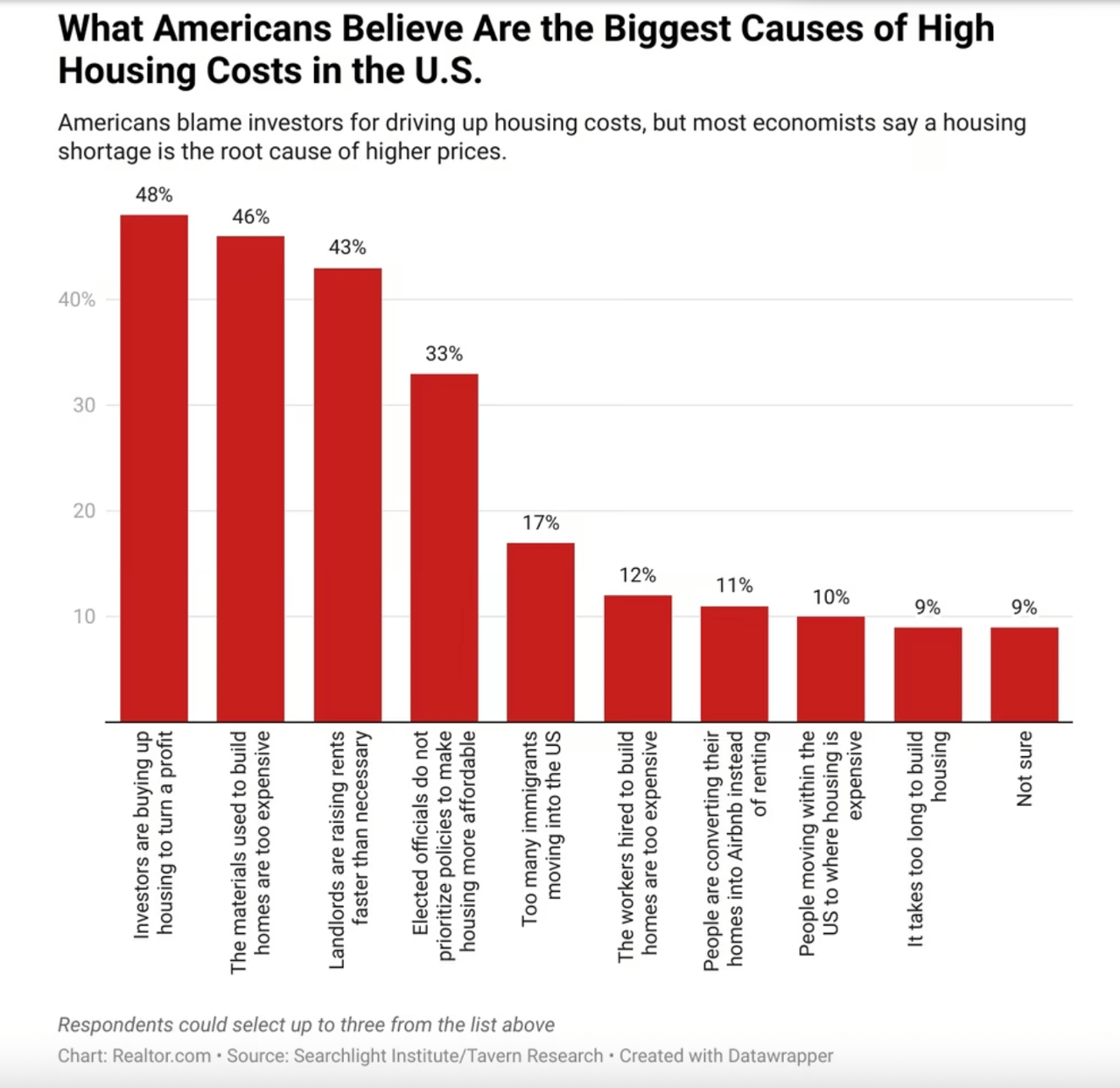
The survey reveals a significant gap between public perception and expert economic analysis. While 48% of respondents blame investors as the primary cause of high housing costs, this contradicts the overwhelming consensus among housing economists who identify housing supply shortage as the fundamental driver.
Economic Evidence:
Most housing economists agree that chronic housing shortage is the main culprit, with Realtor.com's analysis finding the U.S. needs nearly 4 million additional homes
Freddie Mac estimates the current housing shortage at 3.7 million units
Academic research shows that even when institutional investors are active, supply constraints remain the primary cause of price increases
Only 9% of respondents identified the length of time to build housing as a major cause, despite this being a key factor cited by economists and homebuilders. This represents a substantial disconnect between public understanding and expert analysis of regulatory barriers, permitting delays, and construction constraints that limit housing supply
Recent data challenges the survey's findings about investor influence:
Declining Investor Activity: Large investor purchases dropped 90% in early 2023 and remained at historic lows through 2024, yet housing costs continued rising
Net Selling: Investors have been net sellers of properties in recent years, with their ownership share of single-family homes declining by 1.4% over the past decade
Regional Evidence: Analysis shows investors typically follow rather than lead price appreciation, being attracted to markets already experiencing rapid growth
Multiple peer-reviewed studies indicate:
Housing supply elasticity is the primary determinant of price responses to demand changes
Areas with strict supply constraints experience the largest price increases regardless of investor activity
Population growth and household formation in investor-active markets (16.8% vs 7.3% national average) suggest demand pressures, not investor speculation, drive price increases
While the survey accurately captures public sentiment about housing costs, it reveals concerning gaps between public understanding and economic evidence. The data suggests Americans significantly overestimate investor impact while underappreciating supply-side constraints that economists identify as primary drivers of housing unaffordability.
This disconnect has important policy implications, as public support for evidence-based housing solutions may be limited if citizens fundamentally misunderstand the causes of high housing costs. The survey's findings should be interpreted as measuring public perception rather than identifying actual causal factors in housing cost increases.